
Why traffic alone does not bring in leads
It is easy to treat visitor numbers as the measure of a healthy website. Traffic is satisfying to watch, it goes up when you publish something new, and it feels like proof that your marketing is working. But traffic is only the first step in a longer chain. A visitor has to understand what you offer within seconds, trust that you can help, and then take an action: filling in a form, starting a chat, booking a call or picking up the phone. If any link in that chain is weak, the visitor leaves and the traffic count never turns into a lead.

Research on online marketing consistently lists generating traffic and generating leads as two separate challenges, not one. Marketers treat them as distinct problems that need distinct answers, which is a useful reminder that the skills and tools that bring people to a site are not the same ones that persuade them to enquire once they arrive. A site can be very good at the first job and poor at the second, and the traffic reports will look excellent the whole time.
There is also a measurement trap. A site that measures only visits sees success in numbers that say nothing about revenue. When you shift the question from “how many people came” to “how many people did something”, the picture often changes completely. That shift is the starting point for everything below: before you buy more traffic, work out why the traffic you have is not converting.
Is your site speaking to the wrong visitors
The most common reason for high traffic and no leads is a mismatch between the audience and the offer. Broad content brings broad audiences. If your pages rank for questions that people search while researching generally, rather than while looking for a supplier, you will get readers who are curious but never in a position to buy. They read, they leave, and they were never going to enquire. This is not wasted effort exactly, but it is not pipeline either.
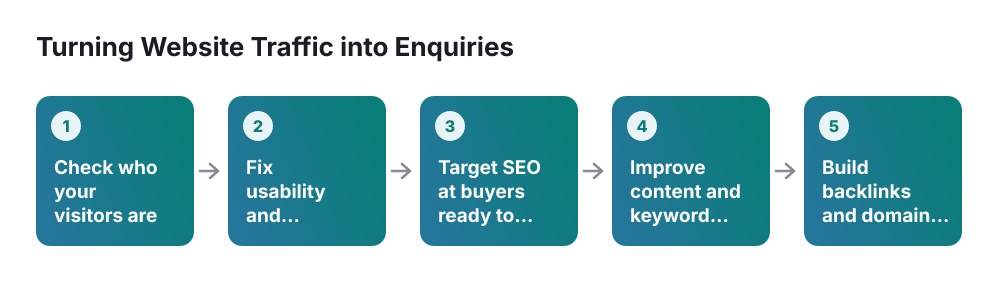
The way visitors arrive matters as much as how many arrive. Studies of news websites have found that social media following relates to traffic, but that kind of traffic reflects general interest rather than commercial intent, and the same applies to most businesses. A visitor who clicks a link out of casual curiosity behaves differently from one who typed a search looking for help with a specific problem. The first needs entertainment; the second needs a clear route to an answer. If most of your traffic comes from the first kind of source, low lead numbers are the expected outcome, not a mystery.
You can diagnose this without any special tools. Look at the pages that receive the most visits and ask what someone reading that page is likely to want. Then look at where your enquiries actually come from and compare the two lists. If the pages that bring enquiries are buried while the busy pages are generic, your traffic is working against you. The fix is not necessarily to delete the popular pages but to build and promote more pages aimed at people who are ready to act.
Common website problems that turn visitors away
Even the right visitors will leave if the site itself gets in their way. Work on website optimization used to mean little more than making pages load quickly; today it covers everything from speed and structure to the clarity of the message and the ease of taking action. A slow page, a layout that breaks on a phone, a navigation menu that hides the pricing or the contact details: each of these quietly removes a share of visitors before they ever reach out.

Research on usability that asks real users what they think of a site finds that people judge usability through their own experience and suggestions, and that acting on those perceptions improves both how the site performs and how it attracts and keeps visitors. The practical translation for a small business is simple: you do not need to guess what is wrong. Watch a few people use your site, or simply read your own enquiry path critically, and the friction points usually become obvious within minutes.
- Pages that take too long to load, especially on mobile connections
- Content that explains what you do but never tells the visitor what to do next
- Contact forms with more fields than the enquiry needs
- No visible way to ask a quick question, so unsure visitors simply leave
- Jargon or vague descriptions that leave the visitor unsure whether you serve someone like them
Each item on that list costs you leads without costing you traffic, which is why the problem goes unnoticed. Your visitor numbers look fine while the enquiry numbers quietly stay flat. Fixing these is usually cheaper and faster than any attempt to bring in more visitors.
How SEO brings visitors who are ready to enquire
Search engine optimization has become a central part of digital marketing strategy, and a study of digital marketing professionals examined its impact on both website traffic and lead generation, evaluating how techniques perform across those dimensions. The relevant point for a business with plenty of traffic but no leads is that SEO can be aimed at either. The same discipline that ranks a general blog post can rank a service page, and the service page attracts a very different visitor.
Visitors from search arrive with intent already formed. They typed what they wanted, and the search engine sent them to you. That does not guarantee a lead, but it starts the conversation much closer to the finish line than a casual click from a social feed. When you plan new pages, favour the searches a person makes when they are comparing providers or looking for help now, over the searches made by someone browsing a topic.
SEO also works in your favour on the website problems described above. Clear page titles, straightforward headings and fast, well-structured pages help search engines understand the site and help visitors use it. Improvements made for one audience tend to serve the other, so a round of optimization work pays twice: it brings more of the right visitors and converts more of the ones who arrive.
Simple steps to turn traffic into enquiries
Start with your enquiry path. Follow it yourself the way a stranger would: arrive on the site from a search, decide whether you understand the offer, and try to make contact. Note every hesitation. Any point where you wonder what to do next is a point where a real visitor leaves. Then shorten the path: fewer form fields, contact details on every page, and a clear next step on each important page.

Next, make asking a question effortless. Many visitors are interested but not yet ready to fill in a form or commit to a call. Giving them a lighter way to start, such as a chat invitation that appears when they have been reading a while, lets them raise their question at the moment it occurs to them. For questions that need a proper conversation, offering a video call gives a warmer first contact than a phone queue, and it lets a small team handle enquiries personally.
Then, check your routing. If enquiries arrive in one shared inbox, response time suffers and leads cool off. Directing each enquiry to the right person immediately, based on the page it came from or the question asked, keeps the reply fast and relevant. If you serve several industries or locations, route by those too so the person who answers already understands the context.
- Audit the journey from landing page to enquiry and remove each obstacle you find
- Identify which pages bring enquiries today and build more pages like them
- Add a low-effort way for visitors to ask questions, such as chat invites
- Offer a personal option, like a video call, for visitors who want to talk
- Route every enquiry to the right person straight away
Finally, measure enquiries rather than visits from now on. When the enquiry count is the number you watch, every change you make gets judged by whether it helps, and the traffic reports become a supporting figure instead of the main one.
The practical next step is to run that audit of your own enquiry path this week: open your site as a stranger would, count the steps between arrival and contact, and remove one obstacle from that path before you spend anything on attracting more visitors.
Frequently asked questions
Why do I get so many visitors but no enquiries?
Usually one of two things is happening. Either the visitors are not the kind who need your service, which is common when traffic comes from broad or general-interest content, or the site makes it too hard to act once they arrive. Review which pages bring your enquiries today, and walk your own enquiry path to find where interested visitors are dropping off.
Should I focus on more traffic or on better conversion?
Fix conversion first. Improvements to the enquiry path cost little, apply to every visitor you already receive, and make any future traffic investment more effective. Once enquiries are flowing from the traffic you have, attracting more of the right visitors multiplies a working system instead of a broken one.
How can SEO help me get leads rather than just visits?
Aim it at the searches people make when they are ready to act: service and comparison pages rather than purely informational ones. SEO work also overlaps with site quality, so clearer structure and faster pages help both rankings and the visitors who arrive.
What is the quickest change I can make today?
Add a simple way for visitors to ask a question without filling in a long form. A chat invite that appears while someone reads, or an offer of a short video call for anyone who wants to talk, turns uncertain visitors into conversations before they leave the page.
